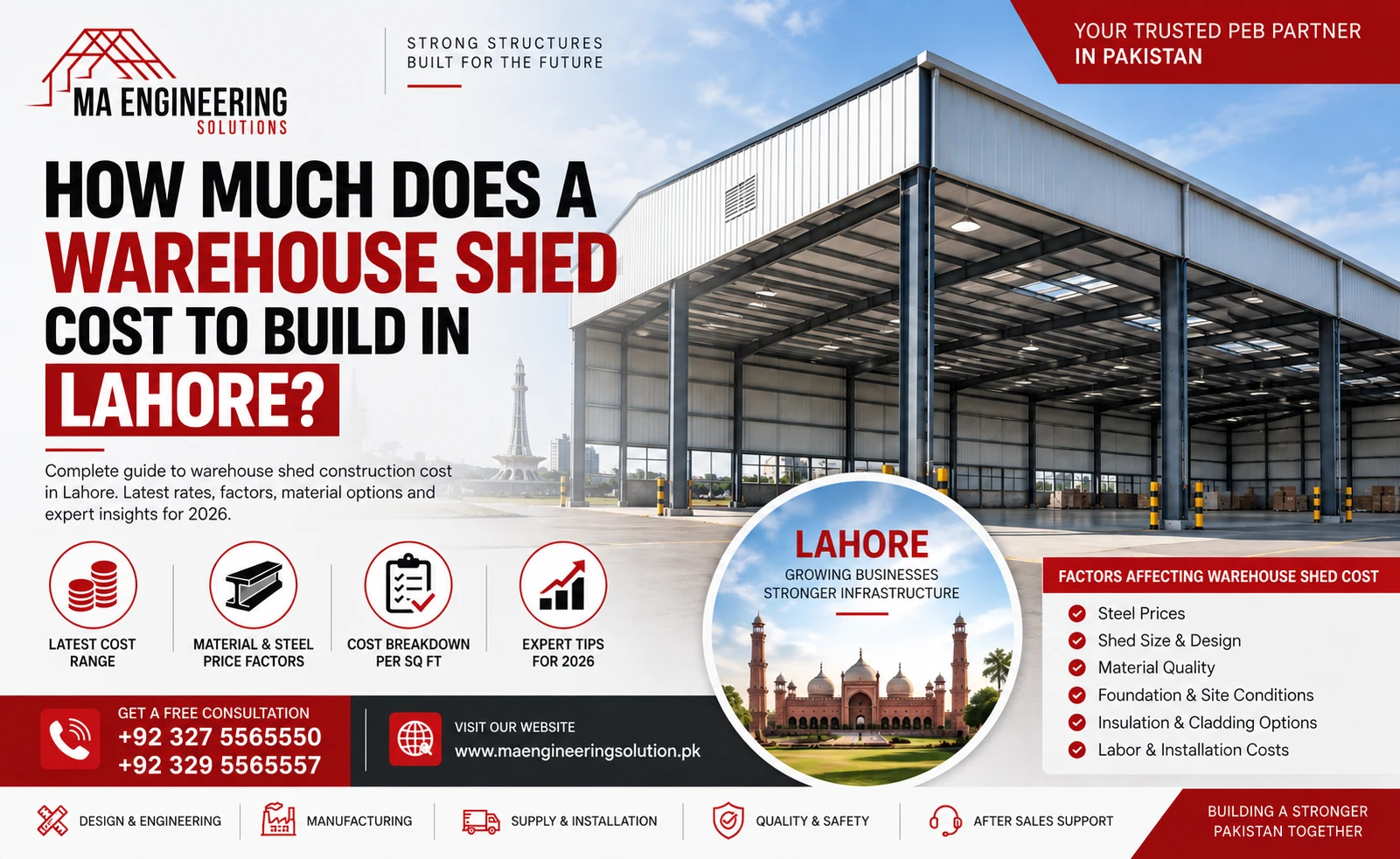
Lahore has become one of Pakistan’s busiest hubs for logistics, e-commerce fulfillment, and light manufacturing — which means warehouse construction demand here has grown fast. If you’re budgeting for a warehouse shed in or around Lahore, the honest starting point is this: cost isn’t driven by location alone, it’s driven by what the warehouse needs to do.
This guide walks through what actually shapes warehouse shed cost in Lahore specifically, so you can budget realistically before requesting quotes.
Why Lahore Is Different From a Generic Cost Estimate
Three things make Lahore-specific warehouse planning slightly different from a generic PEB estimate:
- Land cost and availability in industrial zones (Sundar, Quaid-e-Azam Industrial Estate, Raiwind Road) varies significantly by area, which shapes how much covered area makes financial sense on your plot.
- Site access for heavy transport — steel components are fabricated off-site and delivered by truck, so a site near major arteries like Sheikhupura Road or the Ring Road generally sees lower transport cost than a site in a congested inner-city location.
- Local wind and soil conditions factor into foundation design, which is scoped and costed separately from the steel structure itself.
For a broader breakdown of cost factors that apply across Pakistan, see our guide on PEB shed cost per square foot.
What Drives Warehouse Shed Cost Specifically
1. Clear Span for Racking and Forklift Movement
Most warehouse operations need wide, column-free spans to allow efficient racking layouts and forklift turning radius. Wider spans need heavier primary steel framing, which is usually the single largest cost factor in a warehouse build.
2. Eave Height for Vertical Storage
Warehouses built for high-bay racking (common in 3PL and e-commerce fulfillment) need taller eave heights than a standard single-level storage shed. Height directly affects the steel tonnage required for columns and bracing.
3. Floor Loading Capacity
A warehouse storing palletized goods on racking has very different floor load requirements than one storing loose or lightweight materials. This affects your flooring/civil scope, which is typically quoted separately from the steel structure.
4. Dock Doors and Loading Bays
Each loading dock or large door opening interrupts the structural frame and needs reinforced framing around it. The number of trucks you need loading simultaneously directly affects how many bays — and how much framing cost — your design needs.
5. Roof and Wall Cladding Choice
Plain galvanized sheeting is the standard economical option for dry warehousing. If you’re storing temperature-sensitive goods, insulated sandwich panels reduce heat buildup but add upfront cost — worth comparing against your product’s storage requirements.
6. Fire Safety and Ventilation Requirements
Depending on what’s being stored, your warehouse may need specific ventilation, smoke extraction, or fire-rated partition walls — all of which add to the design and material scope.
7. Future Expansion Plans
If you expect to expand the warehouse in phases, planning the column grid and foundation for future extension now is significantly cheaper than retrofitting an already-built structure later.
Warehouse Shed vs Other Industrial Shed Types
Not every large structure needs to be built like a pure warehouse. If your operation combines storage with manufacturing, an industrial shed or factory shed design might suit better — these are engineered around heavier equipment loads and different floor/utility requirements. A production hall shed is a better fit if you need unobstructed span specifically for assembly-line equipment rather than racking.
Getting this classification right at the design stage avoids paying for structural capacity you don’t need — or under-building for capacity you do.
A Practical Budgeting Approach for Lahore Projects
- Confirm your plot size and industrial zone — this determines your maximum practical covered area and access constraints.
- Define your racking height and layout before finalizing eave height — this is usually decided with your warehouse management/racking supplier in parallel.
- List your loading dock requirements based on expected truck traffic per day.
- Request a site-specific quote that separates structural steel, cladding, flooring, and civil work — this makes it far easier to compare suppliers on equal terms rather than a single bundled number.
Frequently Asked Questions
Get a Warehouse Shed Quote for Your Lahore Project
Every warehouse has different racking, loading, and storage requirements — the fastest way to get an accurate cost is to share your plot size, intended use, and location with our engineering team.
Get a Free Warehouse Shed Quote →
Related reading: PEB Shed Cost Per Square Foot in Pakistan · Warehouse Sheds · Industrial Sheds · Factory Sheds · Production Hall Sheds